
Open Fence Panels for Pools, Backyards, Pets, and Property Enclosures
Aluminum picket fencing is used when a property needs a strong, clean boundary without closing the space off. It works well around pools, backyards, side yards, walkways, pet areas, gardens, front yards, and commercial spaces where visibility, airflow, and long-term appearance matter.
At AluminumFence.ca, we supply aluminum picket fence panels, posts, caps, gates, and hardware for homeowners, contractors, pool companies, builders, landscapers, and commercial projects across Canada. Local pickup is available in Vaughan, Ontario, supply-only orders can be shipped across Canada, and Ontario installation may be available depending on location and scope.

What Is an Aluminum Picket Fence Panel?
An aluminum picket fence panel is an open metal fence section built with vertical pickets, horizontal rails, posts, caps, and fastening hardware. Unlike a privacy fence, a picket fence is designed to define a space without closing it off completely. It creates a clear boundary while keeping visibility through the fence.
That open design is why aluminum picket fencing is often used around pools, walkways, gardens, front yards, townhomes, commercial edges, and backyard areas where people want a proper enclosure but do not want the property to feel boxed in. The fence gives structure, separation, and a finished appearance while still allowing light, airflow, and sightlines.
A well-planned picket fence also makes a property easier to use. It shows where the pool area starts, where the backyard ends, where a walkway leads, where pets can stay, and where guests should enter through a gate. The system is simple, but it solves important layout problems when the fence is measured and planned properly.
Why Picket Fence Panels Are Common Around Pools
Pool fencing needs to do more than look good. It has to create a clear enclosure, support proper gate planning, allow visibility into the pool area, and work with local rules that may cover height, openings, gate swing, self-closing hinges, self-latching hardware, and climbability.
Aluminum picket fencing is popular for pool areas because it keeps the pool visible from the house and yard. That matters for families, rental properties, cottages, commercial pools, and backyard spaces where supervision and visibility are important. A solid privacy fence can block views into the pool area. A picket fence keeps the enclosure open while still defining the boundary.
Pool fence requirements are local, so the final layout should always be checked against the municipality or authority having jurisdiction. The fence height, spacing, gate hardware, latch position, bottom clearance, and nearby climbable objects can all matter. The product can be suitable, but the project still needs the correct layout, correct hardware, and correct installation.
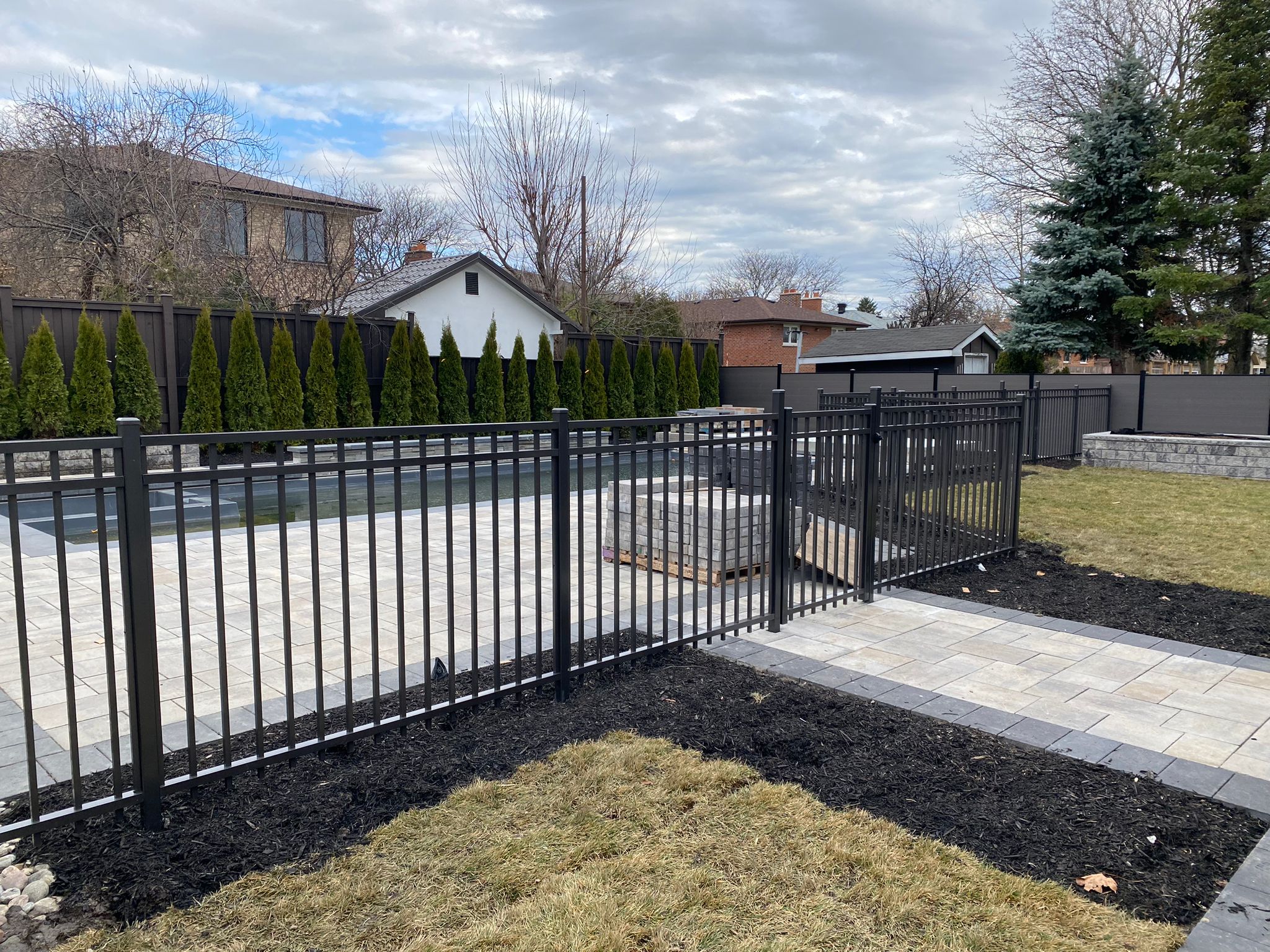
Pool visibility matters
A picket fence keeps the pool area visible while still creating a controlled enclosure. That makes it useful for families, backyard pools, rental properties, and any project where supervision and open sightlines matter.
For pool projects, confirm height, gate swing, self-closing hardware, self-latching hardware, picket spacing, latch height, and local rules before finalizing the order.
Pool Fence Planning Guide
A pool enclosure should be planned before the material is ordered. The fence panel height, gate location, gate width, post size, latch hardware, and connection points can all affect the quote and final installation. A basic material count is helpful, but pool projects deserve extra review because the fence may need to meet local enclosure rules.
| Pool Fence Detail | What to Confirm | Why It Matters |
|---|---|---|
| Fence Height | Common options include 4 ft, 5 ft, 6 ft, 7 ft, and custom heights. | Local pool enclosure rules may require a minimum height depending on the municipality. |
| Picket Spacing | Confirm the opening between vertical pickets and under the bottom rail. | Spacing can affect pool enclosure compliance, pet containment, and overall safety. |
| Gate Swing | Confirm swing direction before ordering gate hardware. | Pool gates may need to swing away from the pool area depending on local requirements. |
| Gate Hardware | Review self-closing hinges, self-latching hardware, lockable latches, and latch height. | Gate hardware is usually one of the most important parts of a pool fence enclosure. |
| Post Size | 2" x 2" and 3" x 3" posts are common options. | Post size affects appearance, strength, gate support, and finished run coverage. |
| Nearby Objects | Check steps, retaining walls, furniture, planters, rocks, trees, and equipment. | Objects close to the fence may affect climbability or inspection results. |
Aluminum Picket Fence Specs and Options
A proper aluminum picket fence order is more than a panel count. The finished project depends on height, width, post size, top style, colour, gate openings, hardware, and the shape of the layout. The calculator helps estimate material quantities, but the final order should still be reviewed before purchase.
Flat Top, Finial, or Plug Style: Choosing the Right Look
Picket top style changes the entire feel of the fence. A flat top aluminum picket fence looks clean, simple, and modern. It is often used around newer homes, pools, front yards, townhomes, and commercial properties where the fence should look refined without feeling overly decorative.
Finial-style pickets create a more traditional ornamental look. This style can work well on brick homes, estate-style properties, formal front yards, older homes, and decorative perimeter fences. Plug-style pickets create a taller vertical appearance while still keeping the fence open and visible.
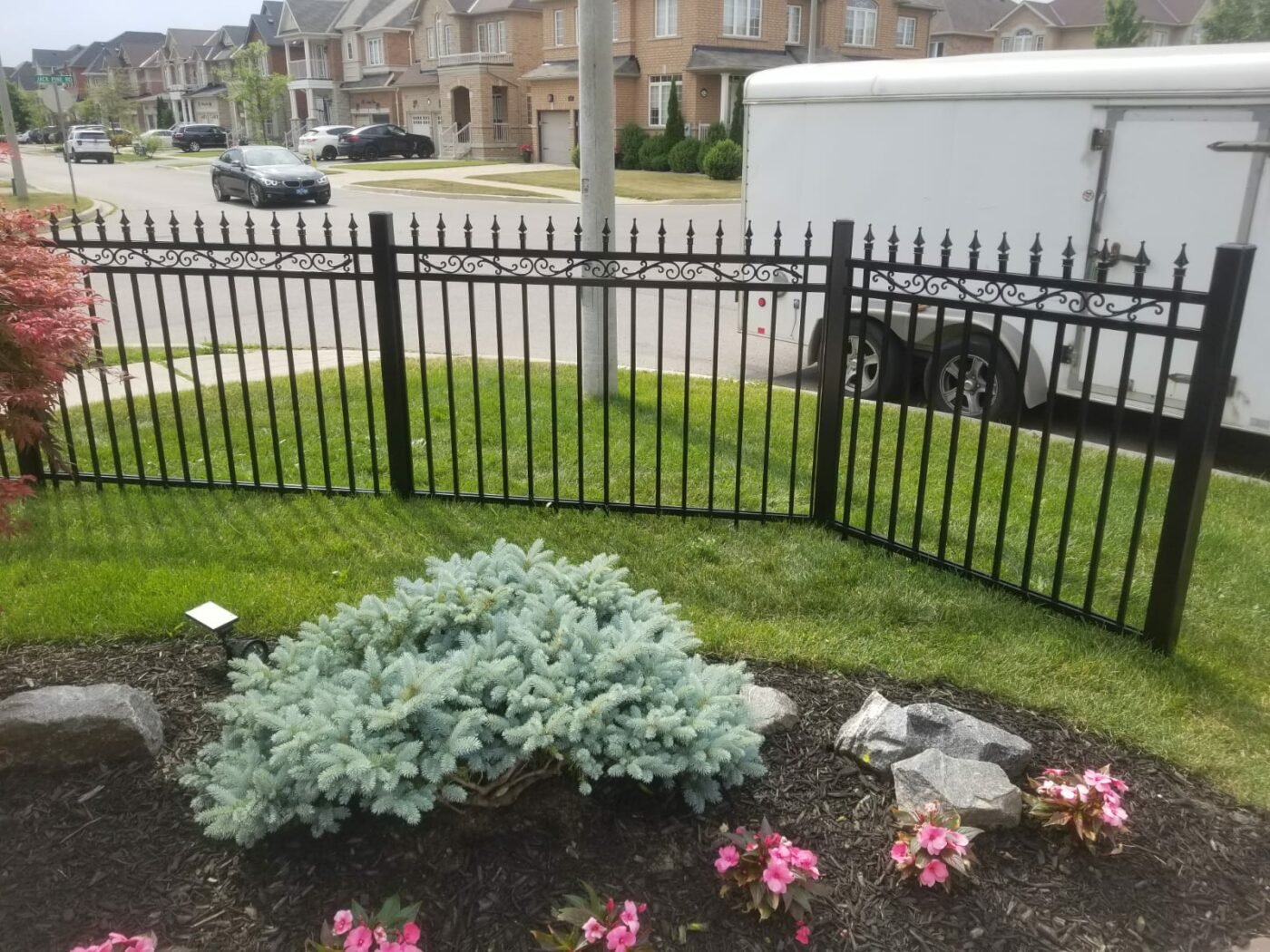
Traditional ornamental picket styles
Finial-style and decorative picket fences are best when the fence is meant to stand out as part of the landscape design. This style works well for front yards, formal gardens, estate-style properties, entrance areas, and homes where a more traditional metal fence appearance fits the property.
The added ornamental detail gives the fence a more classic look than a flat top design while still keeping the yard open, visible, and low maintenance.
Flat Top Style
Choose flat top when the goal is a clean, modern fence with simple lines. It pairs well with pools, contemporary homes, black windows, stone, concrete, glass railings, and minimal landscaping.
Finial or Plug Style
Choose finial or plug style when the fence should feel more decorative, traditional, or architectural. This style is better suited for front yards, classic homes, entrance gates, and formal landscapes.
Photo Examples: Where Aluminum Picket Fencing Works Best
Aluminum picket fencing is strongest when the project needs openness, visibility, and a proper boundary. It is not meant to act like a privacy wall. It is meant to create a clean enclosure that still lets the property breathe.
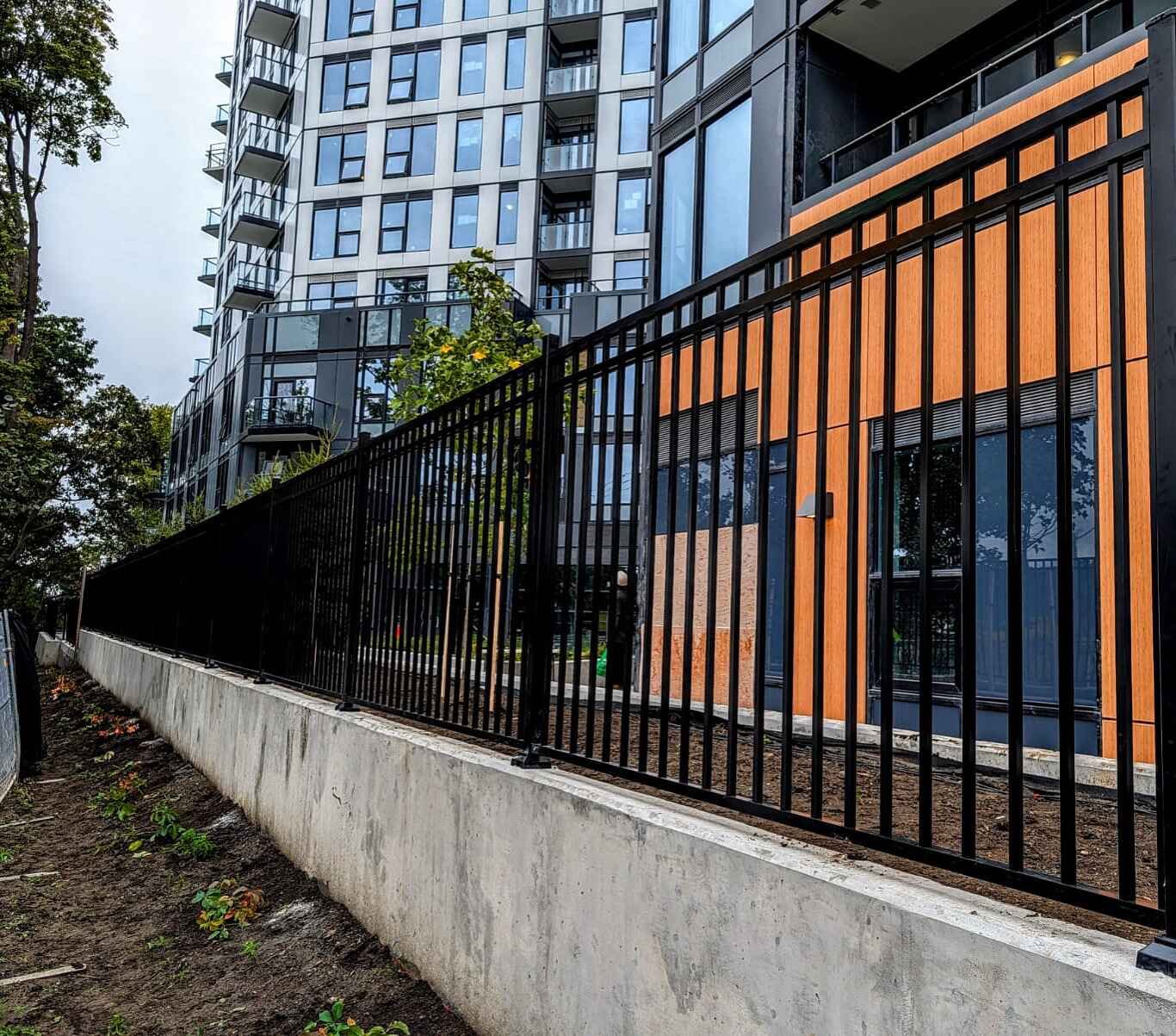
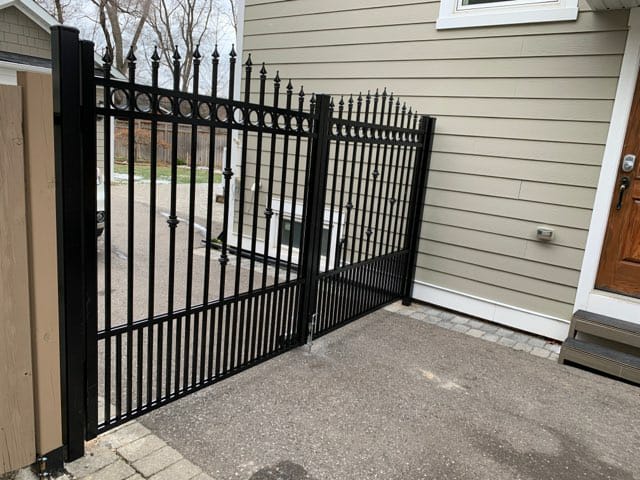
Backyard Enclosures Without Closing Off the Yard
Many homeowners want a backyard fence that feels secure without making the space feel smaller. Aluminum picket fencing is useful because it creates a boundary while keeping the yard open. You can still see landscaping, gardens, pools, patios, pets, and kids playing from different angles.
This is especially helpful for smaller yards. A solid fence can make a small backyard feel boxed in. An aluminum picket fence keeps the boundary visible but does not create the same wall effect. It also works well when the yard backs onto green space, a ravine, a golf course, a landscaped area, or any view the homeowner does not want to block.
Puppy Guard and Tighter Lower Sections
Standard picket spacing is not always ideal for small dogs, puppies, or certain backyard layouts. A puppy guard option can make the lower portion of the fence more secure by tightening the lower spacing or adding a denser lower section. This can help reduce the chance of small pets pushing through the bottom part of the fence.
There are two common approaches. One is a full privacy lower section, which closes the bottom portion of the gate or fence more completely. The other is a tighter lower picket layout, which keeps the fence open but reduces the spacing near the bottom. The better option depends on the dog, the grade, the gate location, and whether the goal is pet containment, added safety, or a more decorative look.


Where Puppy Guard Helps
Puppy guard can help where a small dog or puppy may fit between lower openings, push under a gate, or find a gap near a sloped side yard.
Where Layout Still Matters
A tighter lower section does not replace good layout planning. Gate gaps, slopes, bottom clearance, corners, and transitions into walls or existing fences still need to be reviewed.
Gates Are the Most Important Part of Many Picket Fence Projects
A gate is not just a shortened fence panel. It moves, carries hardware, and gets used repeatedly. Gate posts, hinges, latch type, latch height, swing direction, width, grade, and clearance all matter. A poorly planned gate can sag, drag, swing the wrong direction, fail to latch, or create an opening that does not work for the property.
Pool gates need even more attention because local rules may require self-closing and self-latching hardware. Service gates may need to be wider for lawn equipment, bins, pool equipment, or maintenance access. Double gates may need stronger posts and different hardware than a simple pedestrian gate.
- Confirm each gate opening separately from fence panel footage.
- Decide whether the gate is for people, pool access, pets, or equipment.
- Confirm swing direction before ordering hardware.
- Use stronger posts where gate size or usage requires it.
- Review latch style, lockability, and self-closing hardware where needed.
- Check grade changes so the gate does not drag or leave a large bottom gap.
For matching gates, visit Aluminum Picket Gates or include the number of gates and approximate gate widths when submitting the calculator form.
Aluminum Picket Fence vs Wood, Iron, Vinyl, and Chain Link
Aluminum picket fencing has a specific role. It is not trying to be a full privacy fence and it is not trying to be the cheapest enclosure. It is chosen when the project needs a clean open boundary, low maintenance, visibility, and a more finished appearance than many traditional fence materials.
| Fence Type | Best For | Main Advantage | Main Limitation |
|---|---|---|---|
| Aluminum Picket Fence | Pools, front yards, backyard enclosures, decorative boundaries, open property lines | Clean appearance, visibility, low maintenance, strong pool-style use case | Not intended to provide full privacy |
| Wood Fence | Privacy yards, budget-sensitive projects, natural wood designs | Can provide full visual privacy | Requires staining, sealing, repairs, and long-term maintenance |
| Iron or Steel Fence | Heavy ornamental applications, heritage-style projects, custom welded work | Traditional metal appearance and heavy feel | Can rust when coating is damaged, especially around joints and lower sections |
| Vinyl Fence | Low-maintenance privacy panels and simple residential boundaries | Privacy and simple cleaning | Bulkier appearance and less refined for open ornamental layouts |
| Chain Link Fence | Utility fencing, dog runs, commercial yards, budget containment | Economical and practical over long runs | Less decorative and less premium-looking than aluminum picket fencing |
| Horizontal Aluminum Fence | Privacy screens, modern yards, side-yard screening, patio privacy | Modern privacy and semi-privacy options | Less open than picket fencing and may not be the right look for pool visibility |
Post Size: 2" x 2" vs 3" x 3"
Post size affects both the look and the layout of the fence. A 2" x 2" aluminum post is commonly used for many residential picket fence projects. It keeps the fence lighter and works well for standard open sections. A 3" x 3" post gives the fence a heavier appearance and may be preferred for taller heights, gate areas, commercial properties, or projects where the post needs to look more substantial.
Posts also affect finished coverage. A fence line made from 8 ft panels does not finish at exactly 8 ft per section once posts are included. That is why the calculator asks for post size. The post size changes the approximate finished run and helps create a more realistic material estimate.
Fence Height and How It Changes the Enclosure
Fence height changes the purpose of the fence. A 4 ft aluminum picket fence is often used for pools, decorative yards, gardens, and open property lines. A 5 ft fence adds more presence while still keeping the space open. A 6 ft fence feels more secure and may be chosen for larger backyards, commercial areas, pet spaces, or projects where a stronger boundary is desired.
Taller is not always better. Around a front yard, a lower fence can look more intentional. Around a pool, the required height may depend on local rules. Around a backyard, the right height depends on pets, safety, visibility, landscaping, and how the fence connects to gates or existing structures.
Custom Pickets for Large Slopes
Large slopes are where a standard fence system often starts to look unfinished. On a mild grade, aluminum picket panels can usually be stepped down cleanly from post to post. On a steeper property, however, standard stepped panels can leave large triangular openings under the fence. Those gaps can look poor, create issues for pets, weaken the enclosure, and make a premium fence look like it was forced onto the property instead of built for it.
This is where manufacturing capability matters. AluminumFence.ca can produce longer custom pickets for sloped fence sections so the bottom of the fence follows the grade more closely. Instead of accepting large open gaps under standard panels, we can design the picket lengths around the slope and create a cleaner, more secure, more finished result.
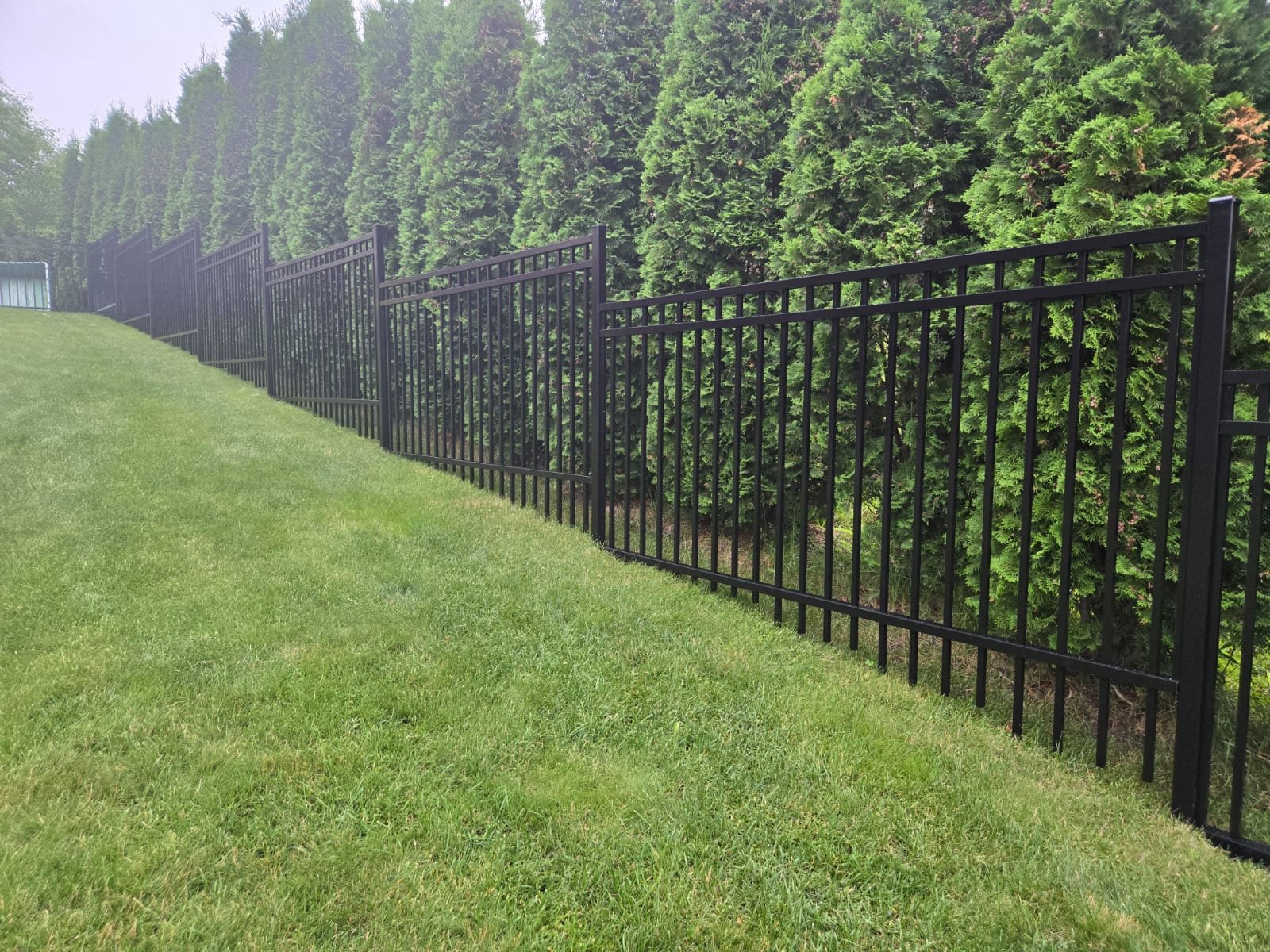
Built for the slope, not forced onto it
Most suppliers can only offer standard fence sections and tell the customer to step the panels down. That may work on a small slope, but it often leaves ugly openings on larger grade changes. Because we manufacture aluminum fence systems, we can supply longer pickets where the grade drops and keep the bottom of the fence much tighter to the ground.
This gives the property a more custom-built appearance and helps improve containment for pets, pool areas, side yards, retaining walls, and landscaped slopes. It is one of the details that separates a basic panel supplier from a manufacturer that understands real fence layouts.
Custom slope pickets are especially valuable when the fence must look clean from the street, when the yard has dogs, when the fence is near a pool enclosure, or when the ground drops quickly between posts. Instead of designing around the limitation of a standard panel, the fence can be manufactured around the property.
Code Awareness: What Customers Should Check Before Ordering
Fence rules can change by municipality. This is especially important for pool enclosures, front yards, corner lots, commercial properties, multi-unit sites, and properties near sidewalks, roads, or public access areas. One city may allow a certain fence height or gate setup while another may require a different detail.
Before ordering aluminum picket fence panels for a pool or safety enclosure, customers should confirm local requirements for height, vertical picket spacing, gate swing, self-closing hinges, self-latching hardware, latch height, bottom clearance, and climbability. If an inspection is required, the inspector will usually care about the installed layout, not just the product description.
Residential Uses for Aluminum Picket Fencing
For homeowners, aluminum picket fencing can make a property feel more complete without blocking the yard. It adds a clear edge around the space and works well with landscaping, interlock, pools, patios, gardens, and driveways.
- Pool enclosures and backyard pool areas
- Front yard decorative fencing
- Side-yard and walkway boundaries
- Pet areas and dog runs
- Garden and landscape borders
- Retaining wall and patio-edge fencing
- Townhome and subdivision fencing
- Open backyard enclosure layouts
Commercial and Multi-Unit Uses
Aluminum picket fence panels are also useful for commercial and multi-unit properties because they look more finished than chain link while still keeping the property visible. This can matter for apartment buildings, townhome developments, schools, parks, offices, churches, retail plazas, daycare areas, and landscaped commercial edges.
For larger projects, send total footage, layout drawings, gate count, height requirements, preferred colour, post size, delivery location, and any site photos through the contact page. Commercial projects often need more review because gates, corners, grade changes, and access points affect the final material list.
How to Measure for Aluminum Picket Fence Panels
A good quote starts with good measurements. Measure each straight run separately instead of only sending one total number. Mark the gates, corners, ends, wall connections, and any area where the fence changes direction.
Simple Measuring Checklist
- Measure each straight fence run in feet.
- Mark all gate locations separately.
- List each gate width if known.
- Choose fence height and colour.
- Select 2" x 2" or 3" x 3" posts if known.
- Note pool areas, pet areas, slopes, or safety concerns.
- Take photos of slopes, corners, steps, and existing structures.
- Use the calculator before submitting the quote request.
What Is Included in an Aluminum Picket Fence Panel Kit?
Each standard aluminum picket fence kit is based around one 8 ft wide fence section. The kit is designed to give customers the core components needed for a standard fence run. Gates, extra posts, delivery, installation, baseplates, and custom hardware may be quoted separately depending on the project.
Delivery Across Canada and Pickup in Vaughan
AluminumFence.ca supplies aluminum picket fence panels for customers across Canada. Supply-only orders can be quoted for delivery based on project size, height, colour, gate requirements, and destination. Local pickup may also be available from Vaughan, Ontario.
Contractors, builders, landscapers, pool companies, and homeowners can use the calculator to estimate materials before requesting a formal quote. For Ontario customers, installation may be available depending on location, access, schedule, and scope of work.
Aluminum Picket Fence vs Horizontal Fence
Aluminum picket fencing and horizontal aluminum fencing solve different problems. Picket fencing is open. It is used for pools, visibility, decorative boundaries, and enclosures where the yard should still be seen. Horizontal aluminum fencing is usually selected when privacy or semi-privacy is the main goal.
If you want to block sightlines, review Aluminum Horizontal Semi-Privacy Fence Panels. If you want an open enclosure for a pool, backyard, front yard, or pet area, aluminum picket fence panels are usually the better match.
FAQ: Aluminum Picket Fence Panels
Are aluminum picket fence panels good for pool enclosures?
Yes. Aluminum picket fencing is commonly used around pool areas because it creates an open enclosure while keeping the pool visible. Local pool enclosure rules should always be checked before ordering or installing.
Do aluminum picket fences provide privacy?
No. Aluminum picket fencing is an open fence style. It is meant for visibility, airflow, decorative boundaries, pool enclosures, and property definition. If privacy is the main goal, a horizontal semi-privacy or privacy fence system may be a better option.
Can aluminum picket fence panels be used for pets?
Yes. Aluminum picket fencing can work well for pets, but the layout should be reviewed for picket spacing, ground clearance, gate gaps, and slope. A puppy guard or tighter lower section may be useful for small dogs.
What is puppy guard on a picket fence?
Puppy guard is a tighter lower section or added lower barrier that helps reduce larger openings near the bottom of the fence. It can be useful for small dogs, puppies, and yards where pet containment is a concern.
Can picket fencing work on a large slope?
Yes. Standard panels can often be stepped down a slope, but larger slopes may leave visible gaps under the fence. AluminumFence.ca can manufacture longer custom pickets for sloped sections, helping close lower openings and create a cleaner, more secure finished result.
What post size should I choose?
2" x 2" posts are common for many standard residential fence sections. 3" x 3" posts may be preferred for taller fences, gate areas, commercial projects, or when a heavier appearance is desired.
What top styles are available?
Common picket fence top styles include flat top, finial-style, and plug-style options. Flat top gives a cleaner modern look, while finial and plug styles create a more decorative or traditional appearance.
Can aluminum picket fence panels be cut down?
Yes. Aluminum picket fence sections can usually be cut down on site to fit shorter runs, end sections, and spaces beside gates or structures.
Do aluminum picket fences rust?
Aluminum does not rust like iron or steel. A properly finished aluminum picket fence is a low-maintenance option for Canadian outdoor conditions.
Do you deliver aluminum picket fence panels across Canada?
Yes. AluminumFence.ca can quote supply-only aluminum picket fence panel orders for delivery across Canada. Local pickup may also be available from Vaughan, Ontario.
Do you install aluminum picket fencing?
Installation may be available for Ontario projects depending on the location, access, timing, and scope of work. Customers outside the installation area can order supply-only material for local installation.
Get a Quote for Aluminum Picket Fence Panels
For the most accurate quote, include total fence length, separate run measurements, fence height, colour, post size, gate count, gate widths, top style, postal code, delivery or pickup preference, project timing, and whether the fence is for a pool, pet area, backyard enclosure, sloped property, or decorative property line.